BACK TO MONTHS
DIRECTIVE // BROWSE ALL

HISTORY TIMELINE

Every milestone across the calendar — 60 space & 60 astronomy events.

JAN10 MILESTONES
ASTRONOMYWinter (annual)

Sirius — brightest star in the sky

The Dog Star reaches its highest culmination on winter evenings in the Northern Hemisphere. At magnitude −1.46 it outshines every other star; the ancient Egyptians used its heliacal rising to predict the Nile flood.

SOURCE
ROBOTICJan 2, 1959

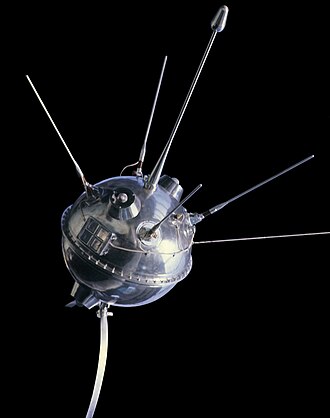
Luna 1 — First craft to escape Earth's gravity

The Soviet Luna 1 became the first spacecraft to reach the vicinity of the Moon and the first to escape Earth's gravity, opening the interplanetary era.

SOURCE
ASTRONOMYJan 3-4 (annual)

Quadrantids meteor shower peaks

One of the strongest annual showers, producing up to 120 meteors per hour at peak. Radiates from the defunct constellation Quadrans Muralis, in the northern sky between Boötes and Draco. Source body: asteroid 2003 EH1.

SOURCE
ASTRONOMY~Jan 3-4 (annual)

Earth reaches perihelion

Every January, Earth swings to its closest point to the Sun — about 147.1 million km. Counterintuitive to Northern Hemisphere winter, but the seasons are driven by axial tilt, not distance.

SOURCE
ROBOTICJan 4, 2004

Spirit rover lands on Mars

NASA's Mars Exploration Rover Spirit bounced to a stop in Gusev Crater on airbags. Designed for 90 days, it survived over six years, discovering evidence of ancient hot springs and past water on Mars.

SOURCE
ASTRONOMYJan 7, 1610

Galileo discovers the moons of Jupiter

Pointing his crude telescope at Jupiter, Galileo saw four 'stars' that shifted position nightly. Within a week he realised they orbited the planet — the first moons found beyond Earth, and hard evidence against a geocentric universe.

SOURCE
ROBOTICJan 14, 2005

Huygens probe lands on Titan

ESA's Huygens descended through the thick atmosphere of Saturn's moon Titan — the first (and only) landing on a body in the outer Solar System.

SOURCE
CREWEDJan 27, 1967

Apollo 1 fire

Astronauts Grissom, White and Chaffee died in a cabin fire during a pre-flight test at Cape Kennedy, forcing a total redesign of the Apollo command module.

SOURCE
CREWEDJan 28, 1986

Space Shuttle Challenger disaster

Challenger broke apart 73 seconds after launch, killing all seven crew including teacher Christa McAuliffe. Root cause: O-ring failure in cold conditions.

SOURCE
ASTRONOMYJanuary 1918

Wolf 359 catalogued

German astronomer Max Wolf identified the faint red dwarf Wolf 359 during proper-motion surveys. At just 7.86 light-years away, it remains one of Earth's closest stellar neighbours — later made famous by Star Trek.

SOURCE
FEB10 MILESTONES
CREWEDFeb 1, 2003

Space Shuttle Columbia disaster

Columbia disintegrated during atmospheric re-entry, killing all seven crew. A piece of foam had damaged the wing's heat shield during launch.

SOURCE
SATELLITEFeb 1, 1958

Explorer 1 — USA's first satellite

Explorer 1 reached orbit and discovered the Van Allen radiation belts — the first major scientific discovery of the Space Age.

SOURCE
ASTRONOMYFeb 8, 1971

Cygnus X-1 identified as a black hole candidate

X-ray observations of the binary system Cygnus X-1 revealed a compact object too massive to be a neutron star. Stephen Hawking famously bet Kip Thorne it wasn't a black hole — and conceded the bet in 1990.

SOURCE
ROBOTICFeb 14, 1990

Voyager 1 takes the 'Pale Blue Dot' photo

At Carl Sagan's request, Voyager 1 turned back at 6 billion km from the Sun and photographed Earth as a single pale blue pixel. Sagan's essay 'A Pale Blue Dot' remains a defining meditation on our place in the cosmos.

SOURCE
ASTRONOMYFeb 17, 1600

Giordano Bruno burned for a plurality of worlds

The Italian philosopher argued the stars were distant suns, orbited by their own planets — some possibly inhabited. The Roman Inquisition burned him at the stake for heresy. Modern exoplanet counts have vindicated him.

SOURCE
OBSERVATORYFeb 18, 1930

Pluto discovered

Clyde Tombaugh spotted Pluto at Lowell Observatory using a blink comparator — the first Kuiper Belt object identified, later reclassified as a dwarf planet in 2006.

SOURCE
ASTRONOMYFeb 18, 1930

Constellation Ursa Major standardised

The IAU formally defined the boundaries of the 88 modern constellations, including the Great Bear (Ursa Major) which contains the Big Dipper asterism. Boundaries drawn by Eugène Delporte, following straight lines of RA and declination.

SOURCE
CREWEDFeb 20, 1962

John Glenn orbits Earth

Aboard Friendship 7, John Glenn became the first American to orbit Earth, completing three revolutions and closing the orbital gap with the Soviets.

SOURCE
ASTRONOMYFeb 23, 1987

SN 1987A supernova erupts

In the Large Magellanic Cloud, a blue supergiant detonated as the closest naked-eye supernova in nearly 400 years. Neutrino detectors on Earth caught the blast three hours before the light arrived — the first observation of a supernova by particle astronomy.

SOURCE
ASTRONOMYFeb 24, 1968

Pulsars announced

Jocelyn Bell Burnell and Antony Hewish published the discovery of a strange, precisely-repeating radio source. Initially nicknamed 'LGM-1' (Little Green Men), it turned out to be a rapidly spinning neutron star — a pulsar.

SOURCE
MAR10 MILESTONES
ROBOTICMar 2, 1972

Pioneer 10 launches

The first spacecraft to cross the asteroid belt and to make direct observations of Jupiter. Pioneer 10 carried a plaque with a message from humanity.

SOURCE
ROBOTICMar 5, 1979

Voyager 1 flies past Jupiter

Voyager 1 made its closest approach to Jupiter, discovering active volcanoes on Io and returning stunning images of the giant planet's atmosphere.

SOURCE
OBSERVATORYMar 7, 2009

Kepler Space Telescope launches

Kepler stared at a single patch of sky for years, confirming over 2,600 exoplanets and revealing that small rocky worlds are common in our galaxy.

SOURCE
ASTRONOMYMar 13, 1781

Uranus discovered

William Herschel spotted what he thought was a comet during a routine sky survey from his Bath garden. It turned out to be the first planet discovered by telescope — and the first new planet since antiquity.

SOURCE
CREWEDMar 18, 1965

First spacewalk — Alexei Leonov

During Voskhod 2, Leonov exited the spacecraft for 12 minutes, becoming the first human to walk in space. His suit ballooned dangerously — he barely got back inside.

SOURCE
ASTRONOMY~Mar 20 (annual)

Vernal equinox

The Sun crosses the celestial equator moving north, giving both hemispheres roughly equal day and night. Astronomically the start of northern spring — and the reference point (0°) for right ascension.

SOURCE
ASTRONOMYMar 25, 1655

Titan discovered

Christiaan Huygens spotted Saturn's largest moon using a telescope of his own design. Titan is the only moon in the Solar System with a substantial atmosphere and stable liquid on its surface (methane and ethane).

SOURCE
ROBOTICMar 29, 1974

Mariner 10 — first flyby of Mercury

The first spacecraft to visit Mercury, and the first to use a gravity assist (from Venus). Mariner 10 revealed a Moon-like, heavily cratered world with a surprising internal magnetic field.

SOURCE
ASTRONOMYMarch 1912

Leavitt's Law — the cosmic yardstick

Henrietta Swan Leavitt published the period-luminosity relation for Cepheid variables, giving astronomers their first reliable way to measure galactic distances. Without it, Edwin Hubble couldn't have proved galaxies exist beyond the Milky Way.

SOURCE
ASTRONOMYMarch-April 1997

Comet Hale-Bopp reaches naked-eye brightness

Discovered in 1995 by Alan Hale and Thomas Bopp, comet C/1995 O1 became one of the most-observed comets of the 20th century. Visible to the naked eye for a record 18 months.

SOURCE
APR10 MILESTONES
ASTRONOMYApr 10, 2019

First image of a black hole (M87*)

The Event Horizon Telescope collaboration released the first direct image of a supermassive black hole's shadow at the centre of galaxy M87 — a glowing orange donut 55 million light-years away.

SOURCE
CREWEDApr 12, 1961

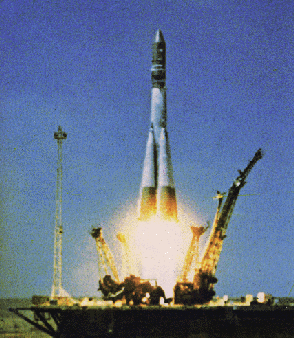
Yuri Gagarin — First human in space

Vostok 1 carried the 27-year-old cosmonaut on a single 108-minute orbit of Earth, making Gagarin the first person ever to leave the planet.

SOURCE
CREWEDApr 12, 1981

STS-1 — first Space Shuttle flight

Columbia lifted off exactly 20 years after Gagarin's flight, piloted by John Young and Robert Crippen. The first (and last, until Shenzhou) reusable crewed spacecraft to reach orbit and be flown home.

SOURCE
COSMOLOGY~13.8 billion years ago

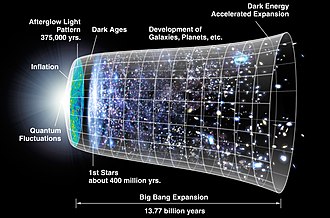
The Big Bang

The cosmos began as an unimaginably hot, dense state and expanded rapidly. Georges Lemaître proposed the 'primeval atom' hypothesis in April 1927, laying the foundation of modern cosmology.

SOURCE
CREWEDApr 13-17, 1970

Apollo 13 — 'Houston, we've had a problem'

An oxygen tank exploded en route to the Moon. Lovell, Swigert and Haise used the lunar module as a lifeboat and returned safely — a successful failure.

SOURCE
ASTRONOMYApr 17, 2014

Kepler-186f — first Earth-size planet in the habitable zone

NASA confirmed the discovery of an Earth-sized exoplanet orbiting within its star's habitable zone. Kepler-186f is about 500 light-years away and could potentially harbour liquid water.

SOURCE
ASTRONOMYApr 22-23 (annual)

Lyrids meteor shower peaks

One of the oldest recorded showers — Chinese astronomers noted it in 687 BCE. Debris from comet C/1861 G1 Thatcher produces ~15 meteors per hour, occasionally with brilliant fireballs.

SOURCE
OBSERVATORYApr 24, 1990

Hubble Space Telescope launched

Deployed from Space Shuttle Discovery, Hubble has since become one of the most productive scientific instruments ever built, redefining astronomy.

SOURCE
ASTRONOMYApr 30, 1006

SN 1006 — the brightest recorded supernova

A stellar explosion 7,200 light-years away outshone every star in the sky, reaching a peak apparent magnitude of about −7.5. Observed by astronomers across the world; visible in daylight for weeks.

SOURCE
ASTRONOMYApr 1054 (approximate)

Chinese astronomers observe the 'guest star'

Court astronomers of the Song dynasty logged a brilliant new star in Taurus, visible in daylight for 23 days and at night for nearly two years. Modern astronomers identify it as SN 1054 — the origin of the Crab Nebula.

SOURCE
MAY10 MILESTONES
ASTRONOMYMay 1, 1930

Pluto officially named

Following its discovery in February, the newly-found ninth planet needed a name. Venetia Burney, an 11-year-old English schoolgirl, suggested 'Pluto' — Roman god of the underworld. Adopted by the Lowell Observatory on May 1, 1930.

SOURCE
CREWEDMay 5, 1961

Alan Shepard — First American in space

Aboard Freedom 7, Shepard flew a 15-minute suborbital flight, making him the second person in space (after Gagarin) and America's first astronaut.

SOURCE
ASTRONOMYMay 5-6 (annual)

Eta Aquariids meteor shower peaks

Debris from Halley's Comet produces one of the most reliable annual showers, with up to 60 meteors per hour visible from the Southern Hemisphere and tropics. Radiates from the constellation Aquarius.

SOURCE
SATELLITEMay 14, 1973

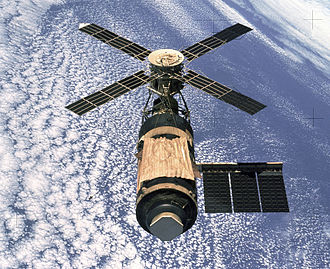
Skylab — America's first space station

Launched aboard the final Saturn V, Skylab hosted three crews between 1973–1974 and pioneered long-duration living and working in orbit.

SOURCE
SATELLITEMay 15, 1958

Sputnik 3 — first orbital science lab

The Soviet Union's third satellite carried 12 scientific instruments — cosmic ray detectors, ion traps, magnetometers — becoming the first true orbital laboratory.

SOURCE
ASTRONOMYMay 18, 1910

Halley's Comet — Earth passes through its tail

Halley's 1910 apparition brought Earth within 0.15 AU of the comet. Some newspapers spread fear about cyanogen gas in the tail; astronomers documented the closest approach in modern times.

SOURCE
SCIENCEMay 25, 1961

Kennedy commits to the Moon

Before a joint session of Congress, President Kennedy declared the United States would land a man on the Moon and return him safely before the decade was out.

SOURCE
ASTRONOMYMay 29, 1919

Einstein confirmed — the Eddington eclipse

During a total solar eclipse, Arthur Eddington measured the deflection of starlight passing near the Sun. The result matched Einstein's General Relativity, not Newtonian gravity — instantly making Einstein a global celebrity.

SOURCE
CREWEDMay 30, 2020

Crew Dragon Demo-2 — First commercial crewed launch

SpaceX's Crew Dragon carried NASA astronauts Behnken and Hurley to the ISS, ending nine years of US reliance on Russian Soyuz launches.

SOURCE
ASTRONOMYMay 1961

Discovery of Sagittarius A* region

Radio astronomers began mapping the compact radio source at the centre of the Milky Way. Decades later, the object was confirmed as a supermassive black hole 4 million times the mass of the Sun.

SOURCE
JUN10 MILESTONES
CREWEDJun 3, 1965

First US spacewalk — Ed White

During Gemini 4, Ed White floated outside the capsule for 23 minutes attached by a golden tether — America's first EVA.

SOURCE
CREWEDJun 16, 1963

Valentina Tereshkova — First woman in space

Vostok 6 carried the 26-year-old textile worker on a solo three-day flight of 48 orbits — more time in space than all US astronauts combined at that point.

SOURCE
CREWEDJun 18, 1983

Sally Ride — First American woman in space

Aboard Shuttle Challenger STS-7, physicist Sally Ride broke a barrier that had stood for 22 years since Tereshkova's flight.

SOURCE
ASTRONOMY~Jun 20-21 (annual)

Summer solstice (Northern Hemisphere)

The Sun reaches its highest point in the northern sky, delivering the longest day of the year above the equator. Marks the astronomical start of northern summer and the origin of solstice-aligned monuments like Stonehenge.

SOURCE
CREWEDJun 21, 2004

SpaceShipOne — First private crewed spaceflight

Scaled Composites' SpaceShipOne reached the edge of space with pilot Mike Melvill aboard — the first non-government crewed spaceflight, winning the Ansari X Prize months later.

SOURCE
ASTRONOMYJun 22, 1978

Charon — Pluto's moon discovered

James Christy noticed a bulge on Pluto's image that shifted with time. Charon turned out to be so large relative to Pluto that the two form a double dwarf-planet system, tidally locked to each other.

SOURCE
ASTRONOMYJun 22, 1633

Galileo forced to recant heliocentrism

The Roman Inquisition convicted Galileo of heresy for defending the Copernican model. Under threat of torture, he abjured his views — reportedly muttering 'E pur si muove' ('and yet it moves') as he left.

SOURCE
CREWEDJun 30, 1971

Soyuz 11 tragedy

After the first crewed stay aboard a space station (Salyut 1), cosmonauts Dobrovolski, Patsayev and Volkov were killed when a vent valve opened during re-entry. The only humans to die in space beyond the Kármán line.

SOURCE
ASTRONOMYJun 30, 1908

The Tunguska event

A 12-megaton airburst over Siberia flattened 2,000 km² of forest — likely a small asteroid or comet fragment exploding at altitude. The largest impact event in recorded history, and a stark reminder of Earth's cosmic neighbourhood.

SOURCE
ASTRONOMYJun 2016

Proxima b — nearest exoplanet

An Earth-mass planet was found orbiting Proxima Centauri, just 4.24 light-years away. Located in the star's habitable zone, it remains the closest known potentially habitable world — a plausible first destination for interstellar probes.

SOURCE
JUL10 MILESTONES
ROBOTICJul 1, 2004

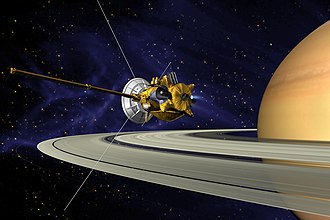
Cassini enters Saturn orbit

After a seven-year journey, Cassini became Saturn's first artificial satellite. It would go on to reveal geysers on Enceladus, methane lakes on Titan, and Saturn's braided rings.

SOURCE
ASTRONOMY~Jul 3-4 (annual)

Earth reaches aphelion

Six months after perihelion, Earth swings out to its farthest point from the Sun — about 152.1 million km. Despite the added distance, the Northern Hemisphere is in high summer thanks to axial tilt.

SOURCE
ROBOTICJul 4, 1997

Mars Pathfinder & Sojourner land on Mars

The first successful Mars landing in 21 years delivered the tiny Sojourner rover — the first wheeled vehicle to operate on another planet.

SOURCE
ASTRONOMYJul 4, 1054

The Crab Nebula progenitor supernova

SN 1054 exploded 6,500 light-years away in Taurus, briefly reaching apparent magnitude −6 — bright enough to see in daylight for 23 days. The expanding remnant is now the Crab Nebula (M1), a laboratory for high-energy astrophysics.

SOURCE
ASTRONOMYJul 14, 2015

New Horizons flies past Pluto

After nine years and 5 billion km, the spacecraft returned the first sharp images of Pluto — revealing the heart-shaped Tombaugh Regio, water-ice mountains, and a surprisingly active surface.

SOURCE
ASTRONOMYJul 16-22, 1994

Comet Shoemaker-Levy 9 impacts Jupiter

Fragments of a fragmented comet slammed into Jupiter over 6 days, leaving Earth-sized dark scars visible in amateur telescopes. The first solar-system impact humans directly observed — a wake-up call about the threat of comets and asteroids.

SOURCE
CREWEDJul 17, 1975

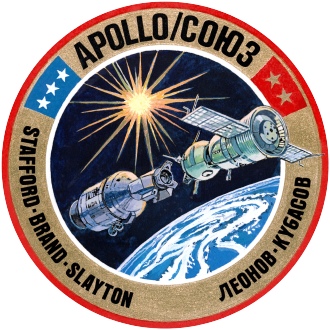
Apollo-Soyuz — Cold War handshake in orbit

US and Soviet crews docked their spacecraft and shook hands 220 km above Earth — the first international crewed spaceflight and a symbolic thaw of the space race.

SOURCE
CREWEDJul 20, 1969

Apollo 11 — First humans on the Moon

Armstrong and Aldrin walked on the Sea of Tranquility while Collins orbited above. "That's one small step for man, one giant leap for mankind."

SOURCE
ASTRONOMYJul 28-30 (annual)

Southern Delta Aquariids peak

Best viewed from the Southern Hemisphere and low northern latitudes, this shower delivers up to 20 meteors per hour. Debris trail believed to come from comet 96P/Machholz.

SOURCE
ROBOTICJul 30, 2020

Perseverance rover launches

NASA's Mars 2020 mission delivered the Perseverance rover and Ingenuity helicopter — the first aircraft to fly on another planet. Perseverance is caching Mars samples for a future return mission.

SOURCE
AUG10 MILESTONES
ROBOTICAug 6, 2012

Curiosity lands on Mars

NASA's car-sized rover survived the '7 minutes of terror' Sky Crane descent to touch down in Gale Crater. Still active over a decade later.

SOURCE
ASTRONOMYAug 12-13 (annual)

Perseids meteor shower peaks

The most beloved shower of the year, delivering up to 100 meteors per hour on warm summer nights. Debris from Comet Swift-Tuttle; radiant lies in Perseus, high in the northern sky after midnight.

SOURCE
ASTRONOMYAug 15, 1977

The Wow! signal

Ohio State's Big Ear radio telescope detected a strong, narrowband signal from Sagittarius lasting 72 seconds. Astronomer Jerry Ehman circled the printout and wrote 'Wow!' Never repeated, never explained — the tantalising outlier of SETI history.

SOURCE
ROBOTICAug 20, 1976

Viking 1 returns first colour Mars panorama

Six weeks after landing, Viking 1 delivered humanity's first sharp colour view of the Martian surface — reddish soil, pink sky, alien and familiar at once.

SOURCE
ROBOTICAug 20, 1977

Voyager 2 launches

The only spacecraft to have visited all four gas giants — Jupiter, Saturn, Uranus and Neptune. Still transmitting from interstellar space today.

SOURCE
ASTRONOMYAug 21, 2017

The Great American Eclipse

A total solar eclipse crossed the continental United States from Oregon to South Carolina — the first coast-to-coast US totality since 1918. Peak totality lasted 2 minutes 40 seconds; ~215 million viewers.

SOURCE
SCIENCEAug 24, 2006

Pluto reclassified as a dwarf planet

The IAU adopted a new definition of 'planet,' demoting Pluto and creating the dwarf planet category — a controversial decision that continues to be debated.

SOURCE
ASTRONOMYAug 24, 2006

IAU redefines 'planet' — Pluto demoted

The International Astronomical Union created the 'dwarf planet' category. Pluto no longer met the third criterion (clearing its orbital neighbourhood) and was reclassified. The decision remains contested by many planetary scientists.

SOURCE
CREWEDAug 25, 2012

Neil Armstrong dies

The first human to walk on another world passed away at age 82. Notoriously private after Apollo 11, Armstrong spent his post-NASA years teaching engineering. He described himself as 'a white-socks, pocket-protector, nerdy engineer.'

SOURCE
ASTRONOMYAug 25, 1989

Voyager 2 encounters Neptune

Humanity's only close-up look at the ice giant. Voyager 2 revealed the Great Dark Spot, supersonic winds (2,100 km/h), and geysers of nitrogen on the moon Triton.

SOURCE
SEP10 MILESTONES
COSMOLOGY~4.57 billion years ago

Formation of the Solar System

A collapsing molecular cloud fragment gave birth to the Sun and its planets. Meteorite dating pins this event to within a few million years, with September marking it in Sagan's Cosmic Calendar.

SOURCE
ROBOTICSep 5, 1977

Voyager 1 launches

The most distant human-made object, now over 24 billion km from Earth in interstellar space. Carries the Golden Record — a message to any who might find it.

SOURCE
ASTRONOMYOct 6, 1995 (confirmed Sep)

51 Pegasi b — first exoplanet around a Sun-like star

Michel Mayor and Didier Queloz announced the first confirmed planet orbiting a normal star other than our Sun. A 'hot Jupiter' completing an orbit every 4.2 days, it overturned assumptions about planetary formation and won them the 2019 Nobel Prize.

SOURCE
ROBOTICSep 12, 2013

Voyager 1 enters interstellar space

NASA confirmed the probe had crossed the heliopause the previous August, becoming the first human-made object to enter the space between stars.

SOURCE
ASTRONOMYSep 14, 2015

First direct detection of gravitational waves

LIGO detected the merger of two black holes 1.3 billion light-years away — the first direct observation of gravitational waves, exactly a century after Einstein predicted them. Announced Feb 2016; the discovery signal remains dated Sep 14, 2015.

SOURCE
ASTRONOMYSep 15, 2017

Cassini's Grand Finale — plunge into Saturn

After 13 years exploring the Saturn system, Cassini deliberately dove into the planet's atmosphere to protect its potentially habitable moons from contamination. It transmitted science data until it burned up.

SOURCE
ASTRONOMYSep 16, 1848

Hyperion — Saturn's chaotic moon discovered

William Cranch Bond and George Phillips Bond, along with William Lassell independently, discovered Hyperion — later revealed to have chaotic rotation and a peculiar sponge-like appearance.

SOURCE
ASTRONOMY~Sep 22-23 (annual)

September equinox

The Sun crosses the celestial equator moving south. Day and night are approximately equal worldwide, and northern autumn (or southern spring) officially begins. Also marks the start of Libra in the astronomical zodiac.

SOURCE
OBSERVATORYSep 23, 1846

Neptune discovered by prediction

Johann Galle found Neptune within 1° of where Urbain Le Verrier had calculated it should be, based on perturbations in Uranus' orbit — a triumph of Newtonian physics.

SOURCE
ROBOTICSep 26, 2022

DART impacts asteroid Dimorphos

NASA's Double Asteroid Redirection Test intentionally rammed a 570 kg spacecraft into the moonlet Dimorphos at 22,530 km/h, successfully changing its orbit — the first practical test of planetary defense.

SOURCE
OCT10 MILESTONES
SCIENCEOct 1, 1958

NASA founded

The National Aeronautics and Space Administration officially opened for business, replacing the NACA and consolidating US civilian space efforts.

SOURCE
CREWEDOct 4, 2004

SpaceShipOne wins the Ansari X Prize

Scaled Composites' SpaceShipOne completed two suborbital flights within two weeks, taking home the $10M Ansari X Prize. The proof-of-concept for private crewed spaceflight that would inspire Virgin Galactic.

SOURCE
SATELLITEOct 4, 1957

Sputnik 1 — The Space Age begins

The Soviet Union launched a 58-cm aluminium sphere into orbit. Its steady 'beep-beep' shocked the world and started the space race.

SOURCE
ASTRONOMYOct 6, 1923

Hubble proves galaxies exist beyond the Milky Way

Edwin Hubble identified Cepheid variables in the 'Andromeda Nebula' — using Leavitt's Law, he calculated the object was over 900,000 light-years away, far outside our galaxy. Andromeda was another galaxy, not a nebula. Our universe suddenly got much bigger.

SOURCE
ASTRONOMYOct 9, 1604

Kepler's Supernova (SN 1604)

The last confirmed naked-eye supernova in the Milky Way, blazing in Ophiuchus for 18 months. Johannes Kepler observed and wrote about it extensively; visible in daylight for over three weeks.

SOURCE
ROBOTICOct 15, 1997

Cassini-Huygens launches

The largest interplanetary spacecraft ever launched at the time began a 7-year cruise to Saturn — and delivered 13 years of world-changing science on arrival.

SOURCE
ASTRONOMYOct 19, 2017

'Oumuamua — first interstellar visitor

The Pan-STARRS telescope in Hawaii spotted an elongated object on a hyperbolic trajectory through the Solar System. Its extreme shape and non-gravitational acceleration sparked debate about its origin — comet, asteroid, or something stranger.

SOURCE
ASTRONOMYOct 21-22 (annual)

Orionids meteor shower peaks

The second annual visit from Halley's Comet debris — this time producing up to 20 fast meteors per hour, radiating from the club of Orion. Best viewed after midnight in dark skies.

SOURCE
ROBOTICOct 22, 2008

Chandrayaan-1 launches

India's first Moon mission confirmed water ice at the lunar poles and put ISRO on the global scientific map.

SOURCE
ASTRONOMYOct 28-31, 2003

The Halloween solar storms

A series of massive X-class flares and coronal mass ejections erupted from the Sun. Auroras were seen as far south as Texas; satellites failed, Mars orbiters lost communications, and airline routes over the poles were rerouted.

SOURCE
NOV10 MILESTONES
CREWEDNov 3, 1957

Laika — First animal to orbit Earth

The Soviet dog Laika became the first living creature to orbit the planet aboard Sputnik 2. She died within hours from overheating, but proved life could survive launch.

SOURCE
ASTRONOMYNov 11, 1572

Tycho's Supernova (SN 1572)

Tycho Brahe observed a new star as bright as Venus in Cassiopeia and wrote 'De Nova Stella' — the origin of the term 'nova'. The apparition shattered the Aristotelian belief that the heavens were unchanging.

SOURCE
ROBOTICNov 12, 2014

Philae lands on a comet

ESA's Rosetta mission dropped the Philae lander onto Comet 67P/Churyumov-Gerasimenko — the first controlled landing on a comet nucleus.

SOURCE
ASTRONOMYNov 16, 1974

The Arecibo Message beamed to M13

The 305m Arecibo radio telescope transmitted a 1,679-bit message toward globular cluster M13, 25,000 light-years away. Encoded: numbers, DNA structure, human silhouette, Solar System diagram. The first intentional interstellar message.

SOURCE
ASTRONOMYNov 17-18 (annual)

Leonids meteor shower peaks

Every 33 years the Leonids produce spectacular storms (up to 100,000 meteors/hour, as in 1833 and 1966). In non-storm years, expect ~10-15 per hour. Debris trail from Comet 55P/Tempel-Tuttle.

SOURCE
SATELLITENov 20, 1998

First ISS module launched

The Russian Zarya module reached orbit, becoming the first piece of the International Space Station — now continuously inhabited for over 25 years.

SOURCE
ROBOTICNov 24, 2020

Chang'e 5 — first lunar sample return since 1976

China's ambitious mission collected 1.7 kg of lunar regolith from Mons Rümker and returned it to Earth on Dec 16. The first lunar samples brought home since the Soviet Luna 24 mission 44 years earlier.

SOURCE
ROBOTICNov 26, 2011

Curiosity rover launches

The Mars Science Laboratory began its 254-day trip to Mars, carrying an instrument suite designed to search for the chemical building blocks of life.

SOURCE
ASTRONOMYNovember 1783

First hypothesis of a 'dark star'

The English clergyman John Michell proposed that a star sufficiently massive would have an escape velocity exceeding the speed of light — making it invisible. A prescient description of black holes, 150 years before Einstein.

SOURCE
ASTRONOMYNov 1969

Sagittarius A* radio source located

Radio astronomers pinpointed a compact source at the very centre of the Milky Way. Decades of observation would confirm it as a supermassive black hole — winning Ghez and Genzel the 2020 Nobel Prize.

SOURCE
DEC10 MILESTONES
CREWEDDec 11-14, 1972

Apollo 17 — Last humans on the Moon

Cernan and Schmitt spent 22 hours on the lunar surface. As of today, no one has returned. Cernan's footprints are still there.

SOURCE
ASTRONOMYDec 13-14 (annual)

Geminids meteor shower peaks

Widely considered the best annual shower — up to 150 slow, bright, multicoloured meteors per hour. Uniquely, the parent body is not a comet but the asteroid 3200 Phaethon.

SOURCE
SCIENCEDec 17, 1903

Wright Brothers — First powered flight

Orville flew 12 seconds and 37 metres over Kitty Hawk, North Carolina. Just 66 years later, humans would walk on the Moon.

SOURCE
ASTRONOMYDec 18-28, 1995

Hubble Deep Field taken

Hubble stared at a seemingly-empty patch of sky in Ursa Major for 10 consecutive days. The resulting image revealed nearly 3,000 galaxies — proof that the universe is teeming with structure across billions of light-years.

SOURCE
ASTRONOMY~Dec 21-22 (annual)

Winter solstice (Northern Hemisphere)

The Sun reaches its lowest point in the northern sky — the shortest day of the year. Marks the astronomical start of winter and the origin of many midwinter festivals from Yule to Sol Invictus.

SOURCE
CREWEDDec 21-27, 1968

Apollo 8 — First humans to orbit the Moon

Borman, Lovell and Anders became the first humans to leave low Earth orbit, circle the Moon, and see the whole Earth as a fragile blue marble ('Earthrise').

SOURCE
SCIENCEDec 21, 2015

SpaceX lands a Falcon 9 booster

For the first time in history, an orbital-class rocket landed vertically on solid ground after delivering payloads to space — cracking the door open on cheap reusable spaceflight.

SOURCE
ASTRONOMYDec 25, 1758

Halley's Comet returns as Halley predicted

Edmond Halley died in 1742 without seeing his prediction confirmed. On Christmas Day 1758 — 76 years after its previous passage — the comet reappeared exactly where he'd calculated, cementing his name in history and Newtonian mechanics.

SOURCE
OBSERVATORYDec 25, 2021

James Webb Space Telescope launches

The largest and most powerful space telescope ever built began its journey to the L2 Lagrange point, where it now peers back over 13 billion years into the early universe.

SOURCE
ASTRONOMYDecember 1610

Galileo observes phases of Venus

Venus showed a full range of phases like the Moon — impossible in the Ptolemaic model, but perfectly explained if Venus orbited the Sun. One of the strongest early proofs of heliocentrism.

SOURCE
ASTRONATLAS TRANSMISSIONS · DATA VIA THE SPACE DEVS + SPACEFLIGHT NEWS API·TERMS & CONDITIONS
VISITS //000,891
DIRECTIVE // INSTALL
Install ASTRONATLAS for offline access & home-screen launch.
55
DIRECTIVE // COMMUNITY SUPPORT

Support AstronAcademics

Our educational initiative for students, learners, educators, and curious minds. A single upvote helps us keep the servers running and the mission alive.

HOW TO HELP
  1. Tap UPVOTE US below.
  2. Create a free Emergent account (takes 15 seconds).
  3. Hit the upvote button on the showcase page — that's it.
THIS REMINDER RE-APPEARS EVERY 15 MINUTES · YOU CAN ALWAYS CLOSE IT